Monday, August 1, 2011

Summertime Blues

Summer is my favorite season – always has been. And for most of my youth, my parents put great effort into trying to ruin my summers.... every year they always sent me to Summer School.

I recall when I was growing up people often telling me I was “smart”. That was nice to hear but I was never sure what they were talking about? School was difficult for me; math in particular was always problematic. English was strange as well; I couldn’t figure out why we needed to spend so much time “diagramming sentences”. Who cares what the difference is between an adjective and an adverb is if you can use them correctly. [Those of you among my followers, who are professional writers, please cut me some slack here.]

In either case, I was a mediocre student during most of my school career, grade school and middle school in particular. As a result of my poor grades, my parents figure the best remedy for my poor grades was that I simply I needed MORE school. So each year I was forced to attend Summer School.

I viewed Summer School as punishment by my parents for not doing well in regular school. Summer School was horrible. For one thing NONE of my friends ever had to go to Summer School. So while they were out having fun, I was stuck in “school”. Summer School only ran half-day, so we were out of there by noon. But by the time I got home my friends were long gone who-knows-where! I spent many of my afternoons alone.

My parents were easily swayed by the propaganda about how much “fun” Summer School was going to be. Pictures on the brochure showed kids at the swimming pool, kids jumping on the trampoline. Bulls#*t -- The trampoline was only brought out ONCE; by the time the my turn in line came around the period was over and it was time to head back to math class. I never did get my 2-minutes of trampoline time. Oh and the pool – it was drained every summer for maintenance.

But finally Summer School term would end and I would luxuriate in the brief period before the regular term started up again. Finally I could ride bikes and hang with my buddies. But soon the “Back to School” ads would air on TV reminding me of the impending return to regular school.

By the time I was in High School my parents had stopped sending me to Summer School – probably because it didn’t exist for high schoolers. Most of my friends by then had summer jobs, I had one as well; picking prunes in Northern California. We worked in the mornings, spent the heat of the day swimming in the Russian River, and then we worked again in the cool of the evening. I loved it.

My grades in high school were all over the chart. I got “A’s in Architecture and Physical Education. My PE grade was an enigma to me as I was always the smallest guy in class and sucked at performing any sport except track. I think they gave me “A's” either for my effort... or more likely everyone got an A. I flunked Algebra three times in a row. But I did great in the sciences, Biology in particular.

It was expected in my family that I would go to college. But my GPA was pretty weak. At that time the Vietnam War was ramping up and lots of young guys my age were going into the military. On my 18th birthday I was obligated to visit the US Post Office to register for the Selective Service. It became very clear that if I didn’t get into college, and pronto, I would likely be invited by Uncle Sam to take an all-expenses-paid visit to exotic Southeast Asia.

College took on a new meaning for me – it served as my primarily deferment from being drafted into the Army. My grades were still mediocre but good enough to keep me in school and out of the Army. During those college summers I worked a clerical job for Greyhound Bus Lines. As I would sit at a desk surrounded by inane clerical people for 8 hours a day, I would reminisce about how much I missed getting out at noon back when I was going to Summer School.

I was never drafted.

Tuesday, July 26, 2011

The End of a Long Road

My father-in-law, Melvin, was an accomplished scientist. He remains one of the more highly published researchers at the Oregon State University’s school of Agriculture. He has traveled the globe collecting rare plants and was instrumental in setting up the National Clonal Germplasm Repository network; a virtual Noah’s Arch of plant genetic material. The first was in Corvallis – there are now repositories all over the globe.

But this great mind at age 88 is being ravaged by the early stages of Alzheimer's. Mel can recall the intimate details of how he discovered the treatment for the plant disease “Pear Decline” but he cannot remember what he did yesterday… or even earlier that day.

Mel learned to drive his Dad’s Model-T as a kid. As he tells it, the old rig wouldn’t make it over Utah’s LaSalle mountains in one run. He and his brother would sit in the back of the truck with a big rock between them. As the T chugged up the hill and over-heated, steam boiling from the radiator, the brothers would jump out and put the rock behind the back wheel to keep it from rolling back down the hill. Once it had cooled down, they would grab the rock and chug up the hill as far as they could go, repeating the process chocking the tire of the overheated T with the rock until they reached the summit.

Two weeks ago while on his way back from his monthly Hort department coffee meeting with other retired professors and technicians, Mel was involved in a car accident. Fortunately for all involved, nobody was injured. But Mel’s car was totaled; too old to be repaired, it ended up being scrapped. Mel later received a letter from the Department of Motor Vehicles – he would need to be tested for his continuing ability to drive or lose his license.

Mel recognizes his mental faculties are in decline so after a day of mulling it over, he decided the best thing to do was surrender his driver’s license. This decision was a monumental one for Mel; it marked a milestone in his life… and a blatant reminder that he doesn’t have many more milestones more to go.

In many ways the decision was an easy one for him. Mel's“world” has been rapidly shrinking; he could no longer see to drive at night and he only remembers how to get to a few places like his church or the university campus. He doesn’t remember how to get to our house or even to his wife’s grave site.

Despite the stereotypical metaphor of the DMV as an example of inefficient government bureaucracy, his business with the agency went smoothly and courteously. No long lines or horrendous wait. A few minutes later, when Mel handed the clerk his paperwork with the box checked that he was voluntarily giving up his driving privileges, he told her: “I’ve been driving for seventy-three years and four months.”

He will get his new color picture state ID card in the mail.

Thursday, July 21, 2011

History in Photographs

Ken Burns is recognized as one of the great documentary filmmakers of this century. With works like “Baseball”, “The Civil War” and soon to be released, “Prohibition” his images weave an intricate historical narrative.

An interesting thing about film making, though; it generally involves moving images. Yet Burns’ works contain almost exclusively fixed images; photographs, illustrations and paintings. Most film editing software ( I use Adobe Premiere Pro) allow the editor to animate fixed images, zooming, scaling, shifting axis. This lends a bit more interest to a fixed image and allows the viewer to focus on the scene slightly longer.

An interesting fact is that much of what we know about the Civil War is due to the vast archives of physical images. Many are glass plates, some film on paper. Though celluloid degrades over time, glass plate images are resilient and can last for centuries. With digital technology these can be enhanced through color correction, balance and blemish removal.

Film and film processing is becoming rare, replaced largely by digital camera technology. My wife, who used to develop her own black-and-white film, finally abandoned her 35mm SLR camera and has gone completely the digital route. But the adoption of new technology has now presented us with a new problem – long-term storage and retrieval.

We began collecting digital images with our earliest computers, initially saved to floppy disks, then hard drives. Today in some cases a single photo image file is larger than the entire 20mb hard drive of my first computer! I remember at the time the computer salesman assured me I would “never fill up that hard drive”.

But the insatiable storage demands of data storage, including photographic images, has required me to seek ever larger capacity devices over time. I’ve gone through “Zip” drives, then larger “Jaz” drives. When that became inadequate I began filling up CD’s then larger capacity DVDs; eventually turning to assorted “Tape” drives. As it stands now, much of what I have stored digitally resides on essentially “obsolete” storage devices.

Then there comes that horrible day when the computer fails to fire up. Hard drives have a finite life span, all will eventually fail. My daughter and her husband lost a number of priceless family photos when their notebook PC died. There were no copies, no duplicates.

Of course many today share photographs through uploading them to web archives such as “Shutterfly”, “Flickr” or “Photobucket”. But many online photo hosting services have gone bankrupt and disappeared from the web… along with them your collection of family photos. Will these online resources enjoy the same century long services as have the glass plates and photo paper images from the battle of Gettysburg? Will those photos of your child’s 4 year old birthday party survive somewhere over the next 100 years generations yet unborn to admire?

It’s an interesting question to picture.

Photo above: George Washington Cole, my great great grandfather. Died at the Battle of Champion Hill, Mississippi, 1863

Saturday, July 16, 2011

Health Care Regulatory Malpractice

Back in mid March I went through Aortic Valve replacement surgery. I’m one of the “lucky” ones who have group medical insurance through my former employer. It’s not free though. Here is how the stats for my procedure break down:
Days in the hospital: 23
Doctors and PAs involved in my treatment: 28
Gross charges billed to insurance: $265,136.49
Amount paid by insurance: $246,013.49
Out of cost paid by me: $915.00
Monthly insurance premium: $1,159.52
These are not the final costs; bills continue to “trickle” in. Of the 28 physicians I can recall actually seeing maybe ten.

When President Obama took office, he pushed through an initiative to revamp the medical insurance industry. To my thinking less than half the job has been addressed by this legislation; he focused on the insurance side of the overall health care issue, leaving the medical delivery system relatively untouched. This is like having the fire department trying to save your burning two-story home by trying to put out the fire on the ground level only – the whole upstairs is still a conflagration.

Each of the 28 doctors billed insurance separately, and multiple times for each time they looked at my chart. That means 28 separate financial transactions, not including the labs, hospital, et al. Heck, if a couple of these doctors just wanted to pick up some side revenue, they could have falsely claimed they provided treatment – the insurance company would have no way of knowing. Nor would I.

Pharmaceutical companies charge outrageous prices for their products. True many likely had high product development costs. But they also par with auto companies in the amount of time and money they spend on prime-time television advertising. I have seen as many as three pharmaceutical ads during one spate of commercial breaks. Who pays for that? I can guess.

The two largest medical providers in town share common real estate and parking lots. But they do not share patient medical data between them via their independent computer systems. Yesterday my cardiologist faxed a blood draw request to the lab in the next building. Yes, in the 21st century – FAXED!

I know people love to gripe about government, and Big government at that. But the city doesn’t have two water departments, there is only one DMV in town, people can apply for Food Stamps and Unemployment insurance compensation in one building. More importantly, NONE of these government agencies have CEO’s who draw million dollar annual bonuses.

It all kind-a makes me sick.

Tuesday, July 12, 2011

The Oregon Country Fair

Some call it an "counter-culture event", others a throw-back to the Hippy days of the 1970's. Whatever... the Oregon Country Fair has been a local event since 1969. With attendance upwards of 45,000 fair revelers, the fair draws visitors from throughout the Pacific Northwest.

Having been over a decade since Nancy and I last attended the fair, a group of friends invited us to join them this year. Though not a big fan of crowds, we couldn't resist checking out the Country Fair this year with good friends.

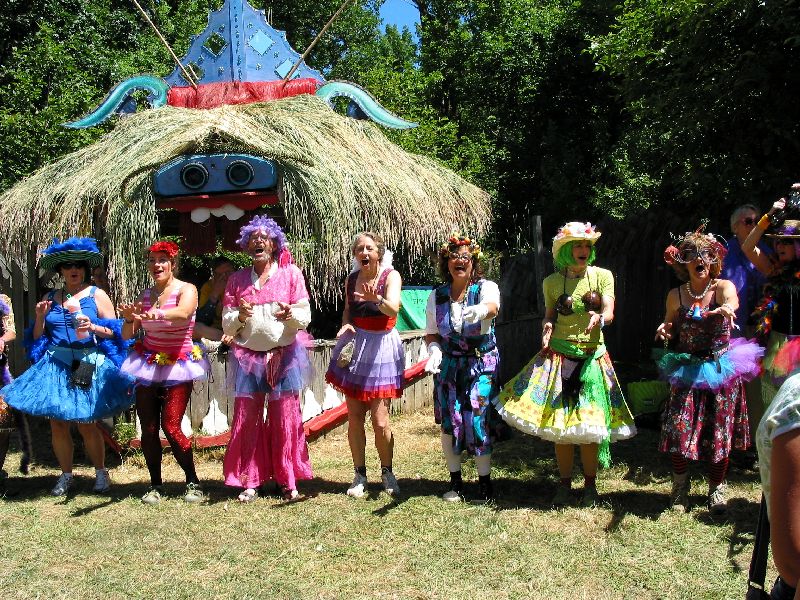
Half of the attraction of the fair are the costumes worn by attendees. We saw Can-Can dancers on stilts, bearded ballerinas and fairies of all ages flitting to and fro. Above, a lone wolf stalks fair goers.

There are upwards of 350 food and craft booths, artists, music and lots of activities for kids. Above, kids peer into a huge Human Kaleidoscope.

Outfits range from the elaborate to the skimpy. Women wearing bras were a rare commodity, and in many cases, tops were dismissed of entirely, replaced by elaborate body paint... or nothing.

I found it interesting how closely the fair almost mirrored the creative and artistic virtual online world of Second Life. The virtual SL world of art, architecture, clothing booths and outrageous costumes emulated remarkably the real life experience of the Country Fair.

Some of us aging hippies were forced to take a needed break to soothe aching feet. I wonder if blue blue body paint helps tired dogs hold up any better?

Half a dozen music stages dotted the grounds. One of the most interesting was the Drum Tower where an incessant beat whipped up the tribal portion of the fair goer's amygdala... mine was pounding in short order, but was easily soothed with a cool hand-dipped ice cream.

I was thoroughly impressed by how well this event is organized. From parking to exiting, and everything in between, friendly volunteers kept operations running smoothly. For an event that attracts attendees one might consider "counter culture" the crowd was fun-loving and convivial; there was no rowdiness or any hint of unpleasant incidents. Alcohol is strictly prohibited and bags are searched before admittance; though there were some questionable brownie recipes passed around and the occasional whiff of smoke from the Cannabis species.

Overall it involved a lot of walking but also a whole lot of fun. We plan on attending the Oregon Country Fair in future years... guys, bring the kids, ladies, leave your bra at home.

Google Images of the Oregon Country Fair
.

Friday, July 8, 2011

Fruit Off the Family Tree

My cousin Nancy (not to be confused with my wife, Nancy) in recent years has developed an interest in family genealogy. This is not something I am particularly interested in, however cousin Nancy contacted me one day, very excited for me to see a picture she had located of my great-grandfather, Bion Franklin Cole.

Pictured left is great-grandfather Bion, on the right is MY college yearbook photo from 1972.

I'm hoping that the family resemblance is limited to physical appearance only. The brief footnote regarding great-grandfather Bion reads: "...died in 1924 in a Hospital for the insane in Nebraska".

Cousin Nancy will be heading back to the family homestead in Wyoming to run down a lead that another of my grand-something's was possibly involved in a lynching of an alleged cattle rustler. More on that story soon.

Monday, July 4, 2011

Patriotism 2011

From the Old Farmer's Almanac:
"Three American presidents have died on the fourth of July. Thomas Jefferson and John Adams died on the same day, in 1826. They had been rivals in everything, even about who would live longest. Adams’ last words were about his long-time foe: “Thomas Jefferson lives!” In fact, Jefferson had died just five hours earlier, but Adams hadn’t gotten the message. James Monroe is the third president to die on July 4th, but he died in 1831."
So to my fellow countrymen: have a safe happy 4th of July. And to my Brit followers; how would you feel about allowing a few of us back in?

Thursday, June 30, 2011

Repo Man - In the Heat of the Night

Previously in my post titled “Repo man – First Blood” I shared one of my stories as a Repo Man during my first two years out of college working for a major Northwest bank. I had been doing this job for several months and had become fairly confident in role as an Outside Collector. Normally the job required me to make contact with delinquent car loan debtors during the day or early evening hours. The tougher cases, where my goal was to repossess the vehicle without customer contact, usually took place under darkness of night during the late evening to early morning hours.

This night was one such case. The debtor had been contacted previously and had not made good on their promise to bring the account current – upon being located, the collateral would be taken on sight. For most of these vehicles the bank had access to the manufacturer’s “key code”. With the code, it was a simple process to have a locksmith make a duplicate set of keys.

This night appeared like it would be just another routine repossession. I cruised the apartment complex were the delinquent debtor lived and quickly located the vehicle. Parking my bank car on the street, I quietly made my way to the collateral, slipped the key into the door, opened it and got in. Now before I would “steal” a car, I would lie down in the driver’s seat so as to not be observed then take a moment to familiarize myself with the controls so I could quickly get away without fumbling. For example, on stick shift vehicles, Reverse would be in different positions on the pattern depending on whether it was an American, Japanese or German car. Once I was ready, I would fire the ignition, throw it into reverse and back out, exit the scene then turn on the headlights when safely away. This had to be done quickly.

Confident I had familiarized myself with the controls, I started the car, sat up, put it in reverse and…. HOOOONNNKKKKK, the horn blared with an incredible noise! Unfortunately, the vehicle had been parked right outside the debtor’s bedroom window – I saw their bedroom light go on as I backed out of their parking space.

Now throwing the shift into drive I turned the vehicle out toward the street. HONK HONKKKK again the horn blared. As I glanced in the rear view mirror I saw the silhouette of the owner looking out the window witnessing their car disappearing into the night.

In preparation as I did prior to any repossession, I had previously located a pay phone booth at a nearby convenience store. I stopped to phone in the repossession report to the local police – they told me owner had already reported that their car had been “stolen”. As I got back into the collateral and gripped the wheel to deliver it to the storage facility, the horn honked again… and continued to honk randomly and unpredictably all the way to the storage lot.

After securing the car safely in storage I realized what had happened. This particular vehicle had been manufactured with a “Rim Blow” horn feature – rather than honking the horn by pressing the center of the steering column, the horn could be honked simply by tightly gripping the steering wheel rim. The idea of the designers at the time was to not have to require a driver to move their hands from the wheel rim to honk the horn. It was a convenience thing. During the tension of my executing the repossession I had been gripping the steering wheel rim tightly enough, causing the horn to honk.

This feature was later abandoned by car manufacturers after it was discovered that a vehicle parked in the hot sun would cause the vinyl in the steering wheel rim to expand, thus setting off the horn. I could imagine hundreds of unoccupied parked cars in Arizona or Texas, their horns blaring away in the heat of Summer sun.

Fortunately, in spite of the blaring horn, I successfully executed the repossession without incident. However, not all repos I did were without confrontation – that story I will save for another time.

Sunday, June 26, 2011

The Usual Suspects

On a New York street witnesses were being interviewed by the police following a deadly subway shooting. When a woman was asked by the police investigating the scene if she saw who the shooter was, she pointed to the young man who had already been placed in the back of a police car. The young man was later arrested for the crime.

A former employee of an armored card company was arrested and put on trial for a brutal beating and robbery of his formal employer. When police questioned the robbery victims, they were shown a picture of their only suspect, the former employee. Yet even though the perpetrator had worn a mask, the witnesses identified him as the robber.

After looking through books of mug-shots, a rape victim was asked later to try to identify her attacker in a police line-up. She picked out the familiar face in the line-up. The man was later convicted for the rape.

All these are actual cases – in all three, eyewitness testimony resulted in the arrest, and in one case, a conviction. In fact, all three suspects were completely innocent of these crimes.

We tend to believe that eyewitness testimony is the most reliable form of evidence. But in recent years, findings are illustrating how fallible our perception and memories actually are. If you watched the video in my previous post, “Eyes Wide Shut", were you one of the many who completely missed seeing the gorilla stroll through the middle of the frame the FIRST time you watched?

Studies have shown that jurors often do not understand, as a matter of common sense, what makes some eyewitness identifications more or less reliable than others. For example, a witnesses’ assuredness in their confidence is not a good predictor of identification accuracy. Add to this the stress which may have been involved during the incident which can reduce the ability to recall details of the face. [1] Witnesses can also be influenced by cross-cultural bias or their memory influenced by information learned following the incident.

In the case of the subway shooting; the witness interviewed by the police did recognize the young man from the subway – but he, like her, had only been another subway passenger. However because the young man had been placed in the back of the patrol car, she made the assumption that the police had arrested the perpetrator. She was only trying to be helpful to the police during the initial investigation.

During the robbery trial of the former armored car employee who was apparently wearing a mask during the crime; his defense attorneys demonstrated that the witnesses were completely unable to recognize identically masked pictures of popular celebrities such as Harrison Ford. The suspect had been suggested to the witnesses by the police; they accepted the suspect’s guilt in spite of having no way to recognize the accused, or anyone, while wearing a mask.

The rape victim had been attacked in a darkened room. Later when presented with the opportunity to identify the suspect in a police line-up, she recognized one of the men she had previously seen in the mug shot book; they were indeed the same person - but he was NOT the person who had actually committed the crime. Interestingly after the man’s conviction was later overturned, he and the victim together went on tour throughout the country giving talks about the dangers and unreliability of eyewitness testimony.

The eyes can be deceived; memory is malleable and subjective. Internal biases and expectations can confirm or erode that which we believe we have witnessed. It is natural for our minds to attempt to make sense of what we perceive and paint a picture of reality. But a number of factors can color that picture with devastating consequences.

References:
1. Schmechel, O’Toole, Easterly & Loftis, 2006, Beyond the Ken, Testing Jurors Understanding of Eyewitness Reliability

Wednesday, June 22, 2011

Wandering in the Wilderness

Being one of those people who are annoyed by door-to-door sales people and wandering religious missionaries in particular, I had placed a “No Soliciting” sign right above my door bell some time back. So then what do the unwanted visitors do? They knock on the door! Explaining the sign to sales people is fruitless; they plead ignorance regarding what “soliciting” is. Religious solicitors don’t believe what they are doing is “soliciting” either – after all, they are on a Higher Mission.

Back then I was very abrupt with visiting religious proselytizers; but not so today. While working on my documentary about magician and inventor, Jerry Andrus, I adopted his approach with missionaries. Jerry was a vocal Agnostic but a very sweet and engaging personality. He would invite visiting missionaries into his home and engage them in debate. Jerry had studied the bible thoroughly and often knew more about the book than the iterate evangelists. Neither, I am sure, believed they were going to change any minds, but Jerry at least hoped they would leave with some alternate concept to consider.

Shortly after moving into our new home, a couple of Jehovah’s Witnesses came to my door; I welcomed them filled with joyful spirit and rapture.

Had I heard about the testament of Jesus Christ, they inquired? I had indeed, was my enthusiastic response; in fact I had been motivated to make all manner of study of the Christian beliefs to such a thorough extent at which I became convinced that there is no such thing as god(s).

The gentleman’s hand froze as he was about to pull a copy of “The Watchtower” from his valise. But surely, the woman missionary interjected, I believed the bible was the “word of god”? “Which bible”, I asked? There are dozens of versions. Clearly none were penned directly by the “almighty” but were rather inspired in the minds of mortal men. I further explained that the people of Jesus’ time spoke Aramaic but the earliest fragments of bible copies (as we have no original) were written in Greek. Surely she didn’t think that Jesus walked around in his time uttering “thee” and “thou”… that is Olde English.

I explained to the woman that, unlike the Bible, the Book of Mormon is claimed to be a “first-hand” account written by a known author, Joseph Smith. I inquired of them both if they thought the Book of Mormon to be a true testament of god? They strongly declined. I suggested that it certainly is easy to make up wonderful and fanciful stories, offering them as “evidence”. But I also reassured them that I didn’t believe that books written about Robin Hood and King Arthur were evidence that those characters were real as well.

By this time the gentleman had tucked his “Watchtower” pamphlet back into his valise; he clearly was not wanting to waste his booklet on the likes of me. As they attempted to back away I explained why I thought the concept of Heaven to be a silly idea and how boring it must be there for people such as me with such creative consciousness to have to spend eternity praising the glory of the lord. By the time I had launched into the findings in Stephen Hawking's new book explaining about Dark Matter and Dark Energy and pre-universe conditions, I clearly had lost them.

I wished them a hearty “Thank you for stopping by”, and sent them on their way with a smile and a friendly wave.

Now I have an inkling of what it must feel like to be filled with the rapture of the Holy Spirit.

Note: After this and a second encounter with Mormon missionaries, I decided to prepare my own pamphlet to hand out in future encounters. You can download a copy of my non-theist pamphlet from my web site. It is not copyrighted so feel free to adapt it for your own use.